CitlaliBridge
Edition 1 · April 2026

Sponsorship Integrity Index

The Wage-Level Shift and the Filing Discipline It Reveals.

Analyzes 2.37 million H-1B LCA filings from FY2022–FY2025 through a single lens — the alignment between what employers claim in their filings and what the data shows they actually do. Every metric measures a claim-vs-reality gap.

14 pages 4 findings DOL OFLC · USCIS Employer Data Hub Free · email required
Download the report
Edition 1
Sponsorship Integrity Index Edition 1 cover page
2.37M
LCA filings analyzed
H-1B · 2,366,848 records · H-1B1/E-3 excluded
FY22–FY25
4 fiscal years
Oct 2021 – Sep 2025
85,005
USCIS rows joined
H-1B Employer Data Hub, FY22–FY23
83.6%
Identity match rate
Filings-weighted LCA → USCIS join

Get the report

Share a work email and we'll unlock the 14-page PDF. One link per request, valid for 15 minutes. No marketing sequences, no re-targeting.

Edition 2 ships Q3 2026.

Your download is ready.

The report should begin downloading automatically. If it doesn't, tap the button below.

Download PDF → Link expires in 15 minutes and is scoped to this session.
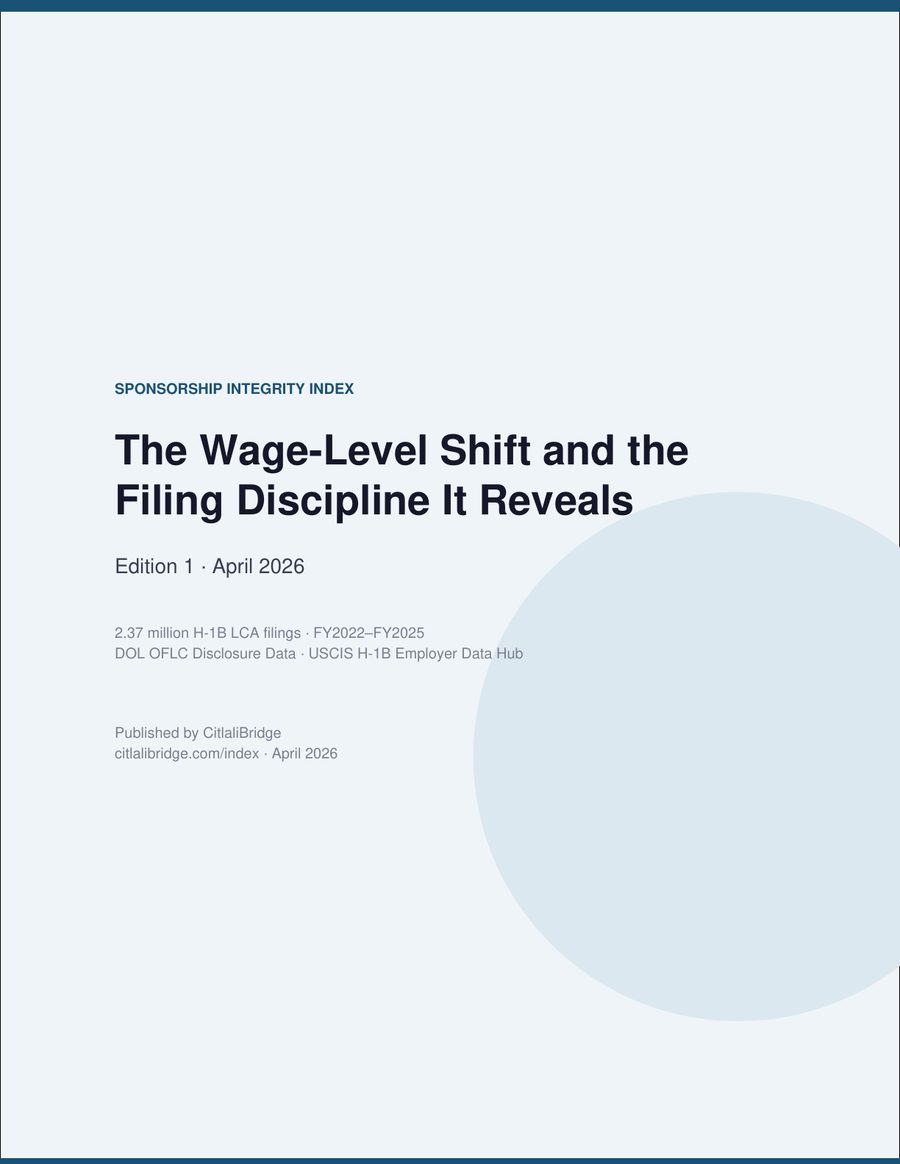
Executive summary

Four findings on sponsorship integrity

Every metric in the Index measures a claim-vs-reality gap. Edition 1 reports four.

Finding 01

The Wage-Level Shift is real, but running the wrong way.

The wage-weighted lottery was designed to reward higher-paid positions. The data shows the opposite direction — and the rise is entirely driven by new, unknown-tier employers, not by established sponsors changing behavior.

+41% cross-industry Level I share (15.0% → 21.0%). Established large-tier sponsors actually reduced their Level I share (6.9% → 6.2%).
Finding 02

Filing discipline moved through a stress cycle, not a breakdown.

The Certified-Withdrawn rate spiked during FY2023 lottery uncertainty, then declined below baseline once the framework clarified. Adaptive behavior, not compliance failure.

CW rate: 5.64% → 6.50% → 5.17% (FY22 → FY23 peak → FY25). Employers used CW LCAs as a hedging instrument, then abandoned the tactic.
Finding 03

The Template Problem is measurable and concentrated.

The Index introduces a new public metric — title_top10_share — measuring the percentage of a cohort's filings that use one of the 10 most common job title strings. Templated filing at scale is the behavioral signature USCIS adjudicators are increasingly equipped to challenge.

33.4% of large-tier Professional & Technical Services FY2025 filings use one of just 10 job titles. "SOFTWARE ENGINEER" alone accounts for nearly 10%.
Finding 04

Extensions are no longer routine, and cost is concentrated in mid-market sponsors.

Continuing denial rates rose materially across every top sector between FY2022 and FY2023. Small-tier sponsors face 2–3x the denial rate of large sponsors in every sector. Mid-market employers who assume scale protects them are wrong.

Information (Tech) denials +84%. Manufacturing +67%. Finance +62%. Small-to-Large denial ratio peaks at 3.22x in Information.
Inside the report

A preview of the executive summary

Full tables, trajectory charts, and the complete methodology are in the 14-page PDF.

The report is published under a single editorial voice. Findings are reported at the cohort level (NAICS 2-digit industry sector × filer size tier); individual employers are not scored or named.

Download the full PDF

Suggested citation

CitlaliBridge (2026). Sponsorship Integrity Index — Edition 1: The Wage-Level Shift and the Filing Discipline It Reveals. https://www.citlalibridge.com/index
Preview of page 2 — Executive Summary
Methodology

How Edition 1 was built

A one-page summary of sources, cohort definitions, and scope. The full methodology with limitations is in the report.

Data sources

DOL OFLC LCA Disclosure Data FY22–FY25 (2,366,848 H-1B records) joined to USCIS H-1B Employer Data Hub FY22–FY23 (85,005 employer-year-state rows).

Cohort definition

NAICS 2-digit industry sector × filer size tier. Tiers by annual USCIS H-1B petition volume: Small (1–49), Mid (50–499), Large (500+), Unknown (no USCIS match).

Identity resolution

Normalized matching — uppercase, punctuation-to-space, suffix stripping, conservative abbreviation expansion. 83.6% filings-weighted join rate.

Baseline

FY2022 is the explicit pre-shift reference — Biden-era adjudication regime after pandemic distortions washed out, before the wage-weighted lottery was publicly discussed.

Scope statement. The Sponsorship Integrity Index measures behavioral alignment between stated and observed sponsorship activity. It does not measure worker harm, immigration policy outcomes, or the merits of any employer's sponsorship program. Elevated risk exposure on any signal does not imply wrongdoing — it identifies patterns that may warrant closer review. Findings are reported at the cohort level only; individual employers are not scored.
Forward look

Edition 2 ships Q3 2026

Edition 2 introduces cohort-level drift distributions — measuring how stable individual sponsors' filing behavior is over time within a cohort — and reports Consistency Integrity as a sixth Index dimension. Derived from the same behavioral scoring framework used in CitlaliBridge's employer trust engine.

This report is provided for informational purposes only and does not constitute legal, compliance, or immigration advice. CitlaliBridge is not a law firm. Readers should consult qualified immigration counsel before making decisions based on these findings. Data sourced from publicly available federal records; accuracy depends on source data quality.