
From Activity to Behavior: The Shift Most Immigration Systems Miss
Modern immigration analytics systems are good at counting activity, but real intelligence begins when systems can interpret behavior, relationships, and patterns across time.
Introduction
Modern immigration analytics systems are built to measure.
They track filings, approvals, denials, and trends across time. They aggregate, visualize, and summarize.
On the surface, this looks like intelligence.
But most of it is not.
Because measuring activity is not the same as understanding behavior.
The Problem with Counting
Most platforms answer variations of the same question:
How much is happening?
- How many LCAs were filed
- How many petitions were approved
- How did volumes change year over year
These are useful metrics.
But they are incomplete.
They describe events, not the system that produced those events.
When Numbers Look the Same, But Reality Isn't
Consider two employers.
Both show:
- similar filing volumes
- comparable approval rates
From a traditional dashboard perspective, they appear equivalent.
But their underlying behavior may be fundamentally different.
One may operate with:
- consistent filing patterns
- stable approval outcomes
- predictable decision cycles
The other may exhibit:
- irregular filing bursts
- fluctuating outcomes
- reactive adjustments to policy changes
The numbers align.
The behavior does not.
And that difference is invisible in most systems.
Why Behavior Matters
Behavior reflects how decisions are made under constraints.
It reveals:
- strategic intent
- operational discipline
- response to regulatory pressure
These are not captured in isolated metrics.
They emerge only when:
- signals are interpreted in relation to each other
- patterns are observed over time
- consistency, or lack of it, is recognized
Without this, analysis remains superficial.
The Limits of Flat Models
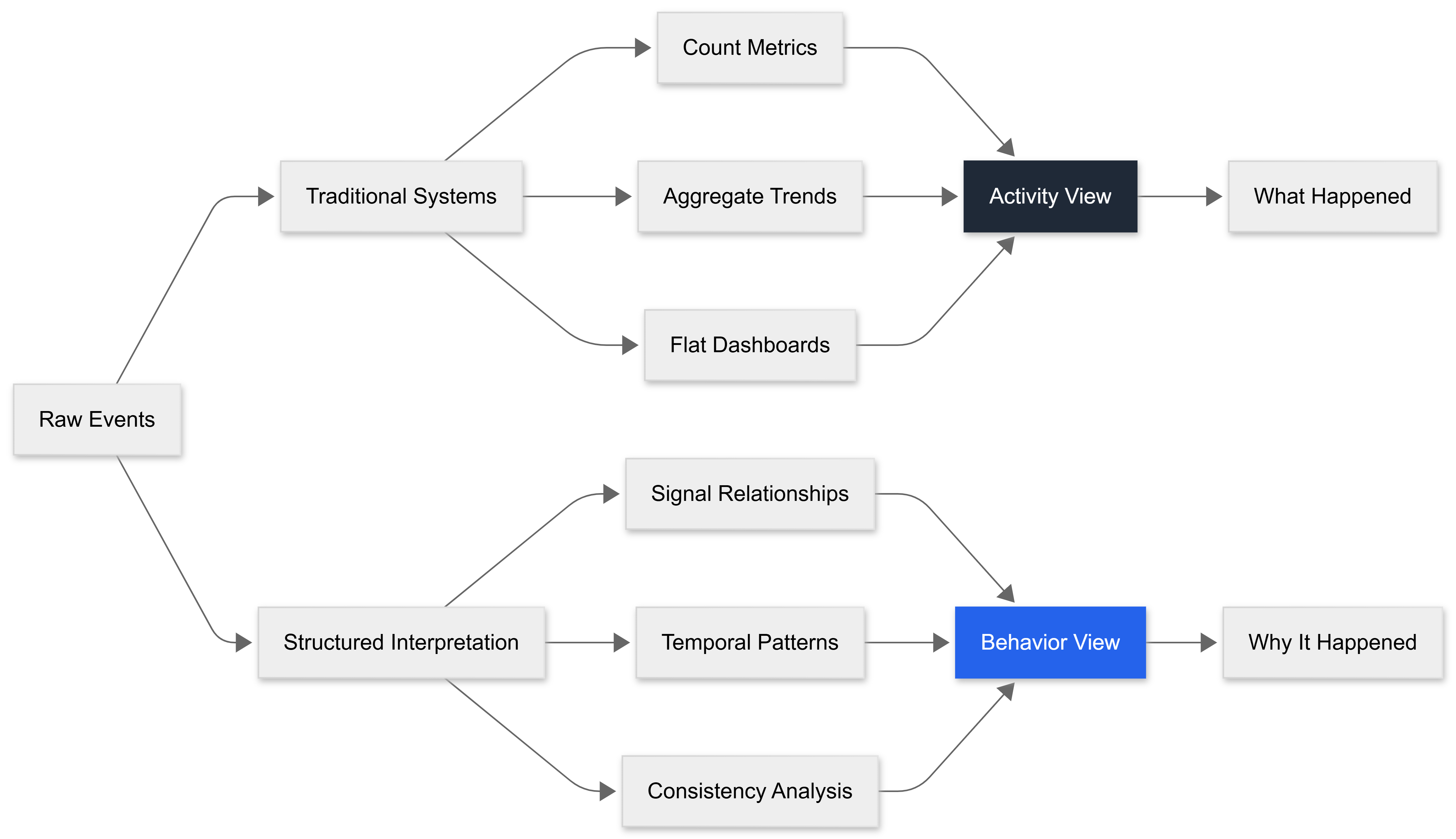
A common design flaw in immigration analytics is the use of flat data models.
Different signals are:
- aggregated
- normalized
- compressed into unified scores or views
This simplifies presentation.
But it removes structure.
And without structure, meaning is lost.
Because not all signals represent the same type of reality.
Some reflect intent. Some reflect outcomes. Some reflect enforcement.
When these distinctions are ignored, interpretation becomes distorted.
From Data Points to Behavioral Signals
To move beyond activity, systems must treat data differently.
Not as isolated points, but as signals within a system.
This requires:
- preserving the context in which data is generated
- recognizing relationships between different types of signals
- analyzing sequences, not just aggregates
Only then does a pattern begin to form.
And only then can behavior be understood.
What Changes When You See Behavior
When behavior becomes visible:
- anomalies stand out
- patterns become explainable
- risk can be interpreted, not just flagged
The system moves from:
reporting what happened
to:
understanding why it happened
This is the difference between analytics and intelligence.
Implications for the Future
As immigration data becomes more accessible, the competitive advantage will not come from:
- who has more data
- or who builds better dashboards
It will come from:
who models reality more accurately
That requires moving beyond flat representations and toward systems that reflect how behavior actually emerges.
Conclusion
Activity is easy to measure.
Behavior is not.
But behavior is where meaning resides.
The next generation of immigration intelligence systems will not be defined by the volume of data they process.
They will be defined by their ability to interpret the system behind that data.
And that shift, from activity to behavior, is where real insight begins.